























3.4. Tripartite Mahzor
(MS A 384)
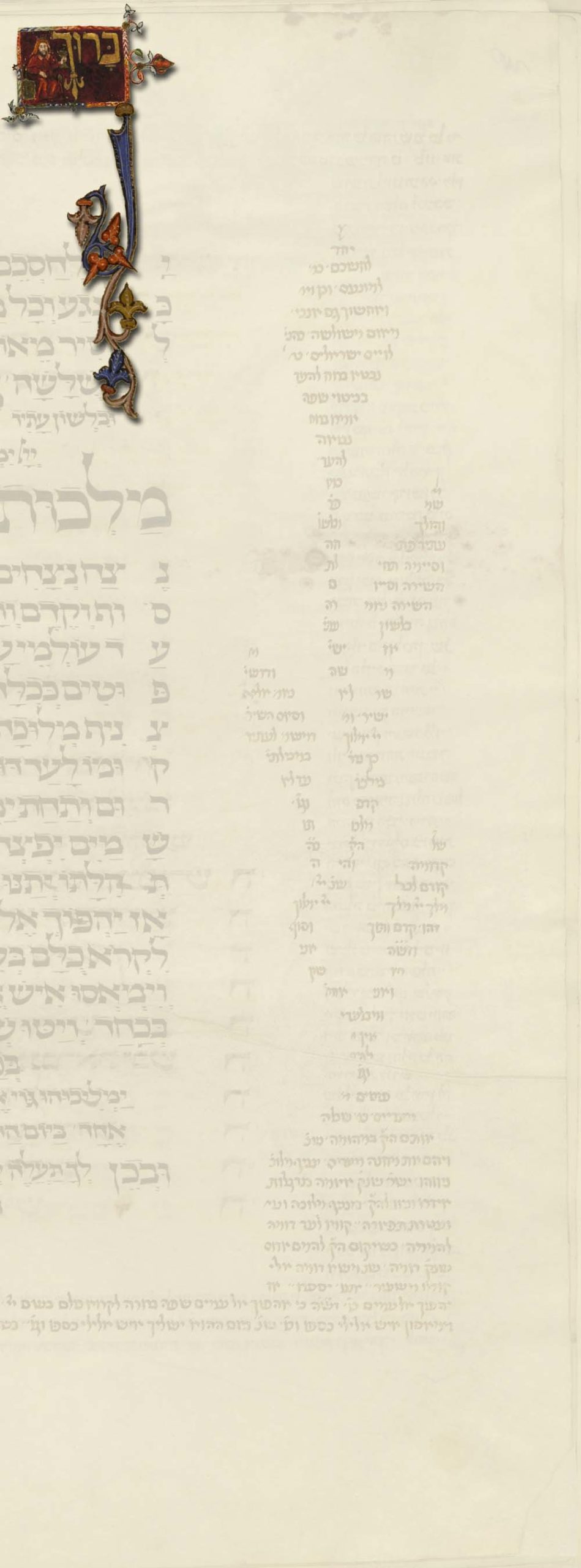
The Mahzor shelf-mark A 384 contains many exciting illustrations, the details of which have not yet been sufficiently researched. This manuscript was written in Southern Germany (in the region of Lake Constance, Bavaria or the region of the Upper Rhine) around 1320. 146 It is also called “Tripartite Mahzor” because Bezalel Narkiss has shown convincingly that it is in fact volume I of a sizeable manuscript consisting of three volumes. The two remaining volumes are preserved in the British Library in London and in the Bodleian Library in Oxford. 147 An interesting characteristic of the manuscript is that human female figures generally appear with animals’ heads. The adoption of animals’ heads occurs in illuminated manuscripts produced in France and
Germany in the 13-14th centuries but the general habit is to represent all human figures, male and female alike, in this way – in contradistinction to our manuscript. 148
There is no universally accepted explanation for this peculiarity. Joseph Gutmann writes:
Most scholars feel that it is attributable to an iconophobic tendency in contemporary German Jewry; one scholar claims that these characteristics are caricatures traceable to the medieval stage; others are convinced that they represented godly grace – elevation above the human. None of these theories is satisfactory, since the evidence of the miniatures contradicts the various hypotheses. In the mystical literature of the circle that gathered around the twelfth-century Judah he-Hasid (Judah, the Pious), we do find mention of dog-headed and bird-beaked human beings. The whole problem needs further study. 149
One of the visitors to our Collection, Ruth Mellinkoff, came to the conclusion during her recent researches that what in fact lies behind the representation of women with the heads of animals – and mainly those considered repulsive in the contemporary imagination – are anti-Jewish feelings of Christian illuminators, who resorted to hidden iconographic allusions which Jewish patrons would not comprehend.
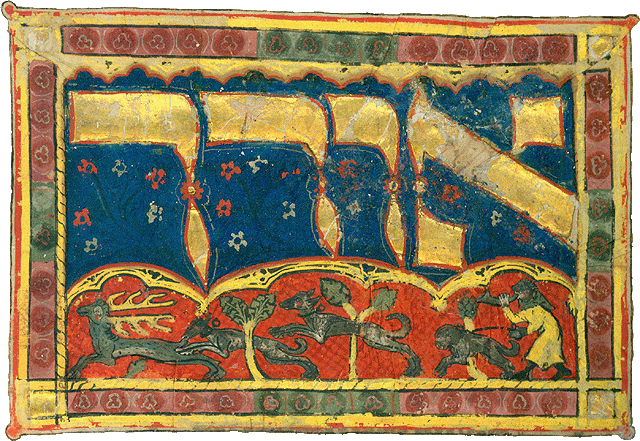
In places one must at least doubt that they would not have comprehended these allusions. It is hardly believable, for instance, that pious Jews would not have been upset by the representations of wild boars in the so-called Second Nürnberg Haggadah (f.7r, f.27r). The interpretation of these scenes is controversial. In so far as one of the wild boars is carrying a device reminiscent of a tabernacle (in the Christian sense of the word) while the other is standing on the top of such a device inside which is seated the head of the family leading the festive ritual, they might symbolize the victory of good over evil, but it is equally possible that they are no more than simple decorations inspired by sudden whims of the illustrator.
In any case, the pig has negative connotations in mediaeval Christian art in general: it is the symbol of gluttony and materialism. 150 The background for the choice of this tabernacle- or monstrance-like device is not clear either; it appears quite often in this manuscript and at times it is placed on the back of various animals and mythological creatures. In addition, quite a number of similar turret- and castle-like devices appear in various places in this manuscript, and King Solomon’s throne is of similar structure too. Consequently, the use of this device as a motif of ornamentation need not necessarily be attributed to a deeper meaning related to the role of the tabernacle and the monstrance in the Roman Catholic Church, but may be rooted simply in the ornamentational vocabulary of the artist. We cannot be quite sure of this, though. This tabernacle also appears in other manuscripts of German origin: Kaufmann terms it “the favourite decoration of the German Haggadah” (diese Lieblingsdekoration der deutschen Haggada), which occurs in most representations of liturgical acts deserving special emphasis. Narkiss and Sed-Rajna use the neutral expression “architectural framework.” 151 Metzger also mentions this motif listing it under the motif of canopy (baldachin) without comment. 152 In general, a tabernacle marks off a space of special rank, of pre-eminent importance. 153
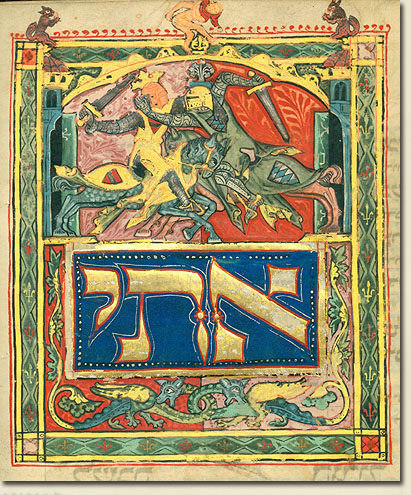
The fact that only women and not men were portrayed with animals’ heads can in Ruth Mellinkoff’s view be explained by the fact that in mediaeval Germany men wore the pointed Jewish hat as a disreputable badge while women did not, so the artist portrayed them with the heads of disreputable animals instead. 154 She detects similar hidden anti-Jewish sentiments in an important illumination (f.103v) displaying in the upper margin a grotesque, perhaps a clown, exhibiting his naked hindquarters in an indecent way. It was mainly on the basis of this illustration, incidentally, that this manuscript could be dated: the figures of the two knights are no doubt an allusion to the battle of Mühldorf, which took place on 28 September 1322 between Frederick the Fair and the friend of his youth, Louis of Bavaria – the arms of Austria and Bavaria appear on the caparisons of the mounts. 155 However, the two fighting knights are also known in Christian art as the representations of the spiritual struggle between righteousness and evil, as illustrated in Psalm I. 156 It is possible that similar anti-Semitic sentiments may also lie behind the frequent occurrence of the representation of the owl in margin illustrations in the Kaufmann Haggadah: in Christian manuscripts the owl is the symbol of the Jews, who – just like the birds of the night – prefer the darkness of evil and sin to the light of the Gospel. 157 Similarly, the occurrence of pigs in certain manuscripts such as the Second Nürnberg Haggadah may bear more or less hidden anti-Semitic connotations: the pig is the symbol of evil, the devil, the sinner, uncleanness, immoderateness, gluttony, unchasteness and wrath. In the 13th century, with the emergence of anti-Semitism, it occurs in Christian art for the first time as the symbol of the Jews, too. 158
Our interpretation of this phenomenon receives a considerably more differentiated background and gains in depth if we consider the situation displayed by the Hebrew manuscript in the National Széchényi Library already referred to above (Sefer Mordechai). In this remarkable manuscript some heads appear in the marginal ornamentation which lend themselves to such an interpretation although such an interpretation is by no means cogent. Now, the heads in question constitute only a tiny minority of the eighty-four (or eighty-five) heads appearing in the manuscript altogether. Other – Christian – manuscripts illuminated by the same artist are known from Lower Austria and similar heads appear there also, this time with bishops’ mitres and monks’ tonsures. Consequently if we interpret his drawings as caricatures then we must admit that our artist was not selective in his dislike: he was equally critical of Christian clerics also. 159 Another aspect of this manuscript is worth mentioning in this context. A few of the heads referred to are placed upside down. This strange phenomenon has been interpreted as a result of the Christian artist’s ignorance of the correct position of the leaves owing to his ignorance of the Hebrew script. As we have shown above, this is out of the question because the general structure of the ornamentation leaves no doubt that the artist was familiar with the correct position of the leaves and he never made mistakes in this respect. Rather, this phenomenon is to be attributed to his playful mind, which tried to lift the boredom of long and tedious working hours with such childish jokes. However, another idea comes to mind also. It has been recorded that in modern states, after great political changes, when for some reason it was impossible to issue new stamps with the portrait of the new ruler, or, in the case of the collapse of a monarchy, with the emblems of the new republic, the old stamps were retained for a while but they had to be put on the envelopes upside down, otherwise they were not valid. So one may ask himself, whether in our case the strange position of the heads could be a source of humour or derision?
85 A kéziratról ld. NARKISS – SED-RAJNA 1988. Tripartite Mahzor, vol. I. Card Nos. 41. A kéziratot Kaufmann Rabbinowitz antikváriustól vásárolta 1883-ban.
86 Bezalel NARKISS: A tripartite illuminated Mahzor from a South German school of Hebrew illuminated manuscripts around 1300. In: Fourth World Congress of Jewish Studies [Jerusalem 1965]. Papers. Jerusalem 1967-1968. II. 129-133. NARKISS egyik tanítványa, Sarit SHALEV-EYNI doktori disszertációt ír jelenleg a teljes kézirat művészettörténeti szempontból.
87 Ld. pl. az ún. Madárfej-haggádát (Bird’s head Haggadah; Israel Museum, Jerusalem, Ms. 180/57), amit azért neveznek így, mert az emberi alakoknak – férfiaknak és nőknek egyaránt – többnyire madárfejük van benne. A kézirat Dél-Németországban készült 1300 körül.
88 COHEN 1988. 49. GUTMANN 1978. 25-26. MELLINKOFF 1999. 11. NARKISS 1967-1968. 133. H. STRAUSS: Die Kunst der Juden im Wandel der Zeit und Umwelt. Tübingen 1972. 56-62 (nem láttam. Idézi MELLINKOFF 1999. 11.)
89 Helyenként az embernek legalábbis kétségei lehetnek, hogy az utalásokat egyáltalán nem értették volna: alig hihető például, hogy az ún. Második nürnbergi haggádában található vaddisznóábrázolások (f.7r, f.27r) egyáltalán ne zavarták volna a hithű zsidókat. Értelmezésük vitatott: azáltal, hogy az egyik tabernákulum-szerű eszközt tart, míg a másik a tetején áll, míg benne foglal helyet az ünnepi rítust vezető családfő, talán a gonosznak a jó által való legyőzetését szimbolizálják, ám könnyen lehet, hogy csak egyszerű díszítések, amelyek egy-egy hirtelen szeszélynek köszönhetik megszületésüket. Mindenesetre a disznó negatív jelentéstartalmat hordoz: ő a falánkság, az anyagiasság jelképe. RÉAU 1955-1959. I. 131. Maga a tabernákulumra, ill. monstranciára emlékeztető eszköz szerepeltetésének a háttere sem világos. Gyakran fordul elő ebben a kéziratban, részben különböző állatoknak, ill. csodalényeknek mintegy a hátán. Találkozunk továbbá ebben a kéziratban több hasonló torony-, ill. várszerű építménnyel is, és Salamon trónusa is ilyen szerkezetű, úgyhogy a tabernákulumra, ill. monstranciára emlékeztető eszköz szerepeltetése valószínűleg egyszerűen a művész által kedvelt díszítő-formanyelvben gyökerezik, az architekturális díszítés eleme csupán, s nem föltétlenül keresendő mögötte valamely mélyebb, a tabernákulumnak, ill. a monstranciának a katolikus vallásban játszott szerepéhez kapcsolódó jelentés. (Bár ezt valójában sohasem tudhatjuk egészen biztosan.) Más német eredetű kéziratban is előfordul: Kaufmann a német haggáda kedvenc díszítésének nevezi (diese Lieblingsdekoration der deutschen Haggada), amely a különösképpen kiemelendő liturgikus cselekmények legtöbb ábrázolásában fordul elő. Narkiss és Séd-Rajna a neutrális „architectural framework” megnevezést alkalmazza. MÜLLER–VON SCHLOSSER: Bilderhaggaden 1898. 136, 157, Tafel XIX. VON SCHLOSSER: Bilderschmuck 1898. 236. KAUFMANN: Bilderzyklen. In: KAUFMANN 1908-1915 III. 235-240. Bezalel NARKISS – Gabrielle SED-RAJNA: Index of Jewish art. Volume II/2 (1978).
The 2nd Nürnberg Haggadah. München – New York – London – Paris 1981. Cards No. 35, 118. Metzger is megemlíti és az illusztrációk között előforduló baldachin-motívumhoz sorolja ezt az elemet, ám nincs mondanivalója róla. METZGER 1973. 3508: „les tabernacles gothiques selon le mot de Müller-Schlosser et de Kaufmann.” Ld. még KAUFMANN: Bilderzyklen. In: KAUFMANN 1908-1915. III. 235. A tabernákulum (cibórium, baldachin) általában véve egy különleges jelentőségű, kiemelt teret határol és különít el. Lexikon der christlichen Ikonographie 1968-1976. I. 240 [s.v. Ciborium, Baldachin].
90 MELLINKOFF 1999. 35-42 (Chapter five: Animals with negative connotations), 56.
91 MÜLLER–VON SCHLOSSER: Bilderhaggaden 1898. 114, 117 (=WEISZ 1906. 124, 125). NARKISS – SED-RAJNA 1988. Tripartite Mahzor, vol. I. Card No. 8.
92 VON SCHLOSSER: Bilderschmuck 1898. 235.
93 RÉAU 1955-1959. I. 131.
94 Lexikon der christlichen Ikonographie 1968-1976. IV. 134-136, esp. 135.