
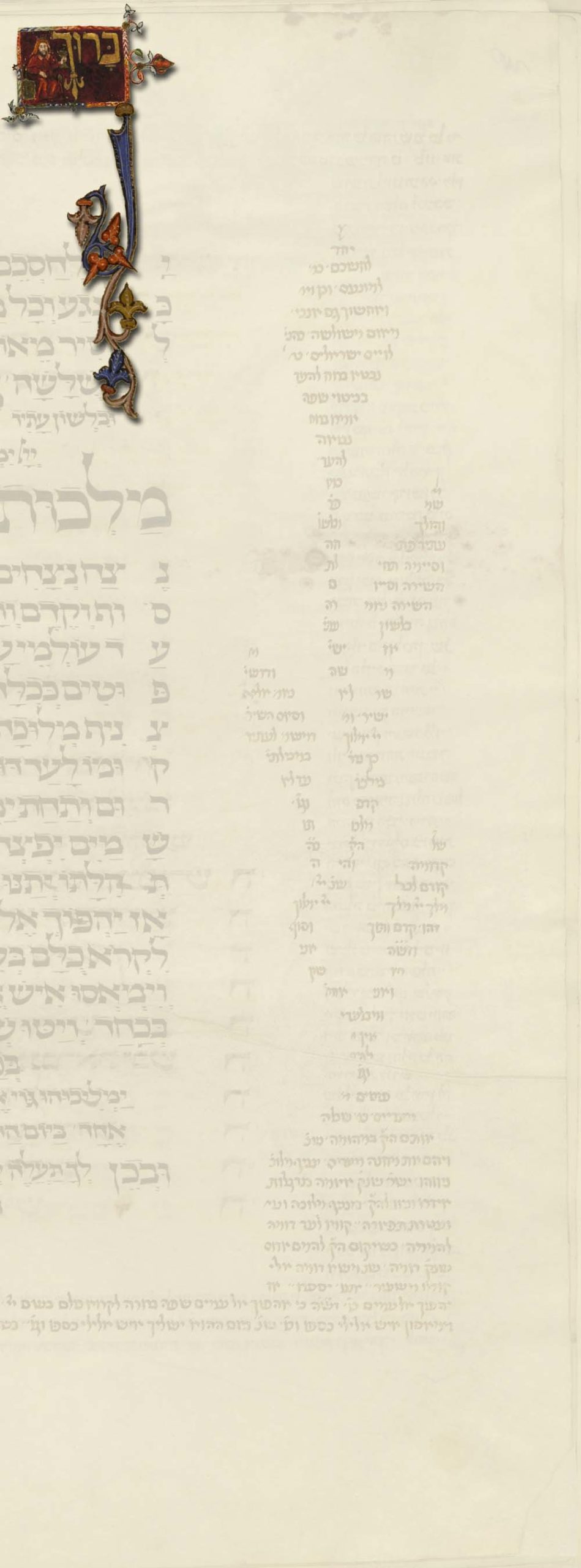























On account of their iconographical interest and simple charm let us select some signs of the Zodiac – in this type of Mahzor they illustrate two piyyuts by Eleazar Kalir (6th c.), the prayer for dew and rain on the Day of Atonement. The types of representation of the signs of the Zodiac in our manuscript closely correspond to similar representations in contemporary Christian calendars, breviaries and psalters. 160 Within the framework of the religio-astrological interpretation of the cosmic system, the Zodiac represents the signs of the night sky while the illustrations of the months stand for the earth by representing the labours characteristic of the given period of the year. 161 The most interesting and most enigmatic of all of them is without doubt the sign of Gemini. Generally, the representation of this sign ranges from a transformation of Castor and Pollux as a caressing pair of a male and female to two armed knights embracing in a fight. 162 In our case we can see two dog-headed figures facing each other holding an unidentifiable device with a shaft in their hands (a mirror with a red frame? a shaft or stick with a red plate? a flower?). 163 It also seems as if the figure on the right had a kerchief on its head, suggesting that the figures are male and female. 164 Such a representation of Gemini is unknown elsewhere in Europe, and Gotthard Strohmaier has succeeded in tracing this motif to the Islamic world at the same time recognizing it also in one of the enigmatic ornamentations of a mediaeval German altarcloth dating from the end of the 13th century, the so-called Zehdenicker Altartuch, one of the treasures of the Märkisches Museum in Berlin. 165
The problem requires further investigation. In the accompanying medallion, in Müller’s and von Schlosser’s view, the female figure can be taken to represent the idealized love of mediaeval German courtly and knightly love, Frau Minne, with crown and sceptre, sitting in the flowering branches of a tree and holding a falcon on her left hand. Narkiss and Sed-Rajna recognize in this figure the labour of hawking or the flower-bearer characteristic of the month of Siwan. 166
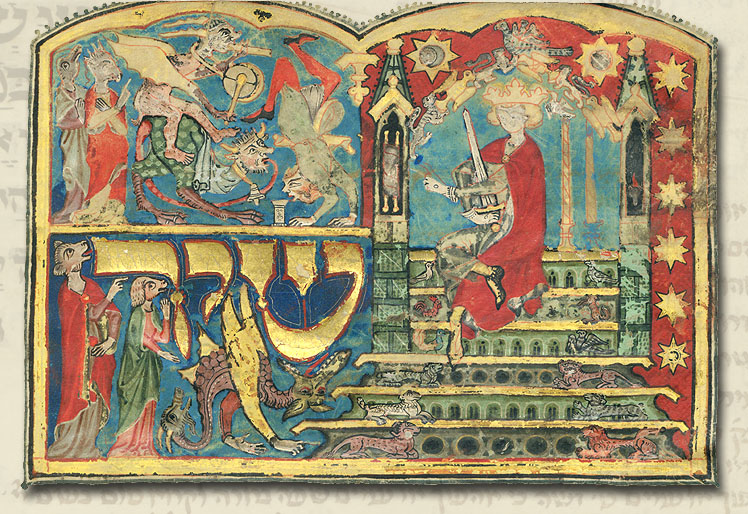
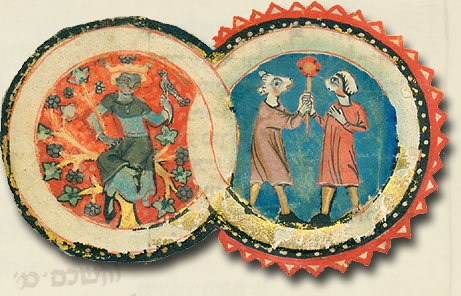
In Sed-Rajna’s opinion the man is wearing a crown. Perhaps rather a falconer’s cap? In general, both motifs – the falconer/hawking and man/woman with flowers – were common for April-May-June and August. 167 Sed-Rajna stresses that the female figure may hark back to an antique prototype, that of Rosalia, too, representing the awakening of Nature. 168 The fantastic representation of Cancer, perhaps betraying Oriental influence, is also remarkable: “a hybrid animal composed of a wolf’s body and head, a griffon’s paws and a fish for a tail” 169 – this type of representation is unique to our manuscript, it cannot be found anywhere else. Next to it we see a man digging the soil as the labour of the month of Tammuz 170 – while the representation of Scorpion as a tortoise should not surprise us, because an illuminator living in the vicinity of Lake Constance at the beginning of the 14th century may not have had the faintest idea what a real scorpion looked like – the labour of the month of Marheshwan is the vine harvest. 171 It may be noted in this context that the representation of Scorpion as a tortoise among the signs of the Zodiac was common in contemporary Christian art, too. 172 The combined sign of Aquarius and Capricorn radiates a certain rustic atmosphere with the beautiful sweep (draw-well) and the kid quenching its thirst from the bucket. Next to it we see in two medallions a sower and a peasant “holding up a boot while warming his bare foot by the fire, above which hangs a cauldron.” 173 The figure of a man warming himself by the fire was a widespread motif in the representation of the winter months (December, January). 174
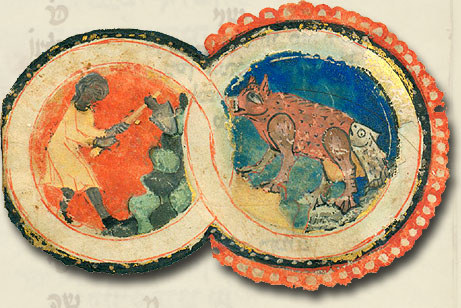
In perhaps the most famous illustration of the whole manuscript, decorating the frontispiece to the Song of Songs, we see King Solomon seated on his throne in the company of his animals with the Queen of Sheba in front of him, whom the artist has portrayed with an animal’s head in the upper left-hand compartment. It seems to be no pure coincidence that Solomon and the Queen of Sheba appear together at the head of the Song of Songs: Solomon is indicated as the author in the title of the work itself, consequently the Lover can easily be identified with him, while a widespread, old tradition going back to Philon of Alexandria and eminently maintained by Isidore of Seville among others identifies the Beloved, the Bride, with the Queen of Sheba. This tradition enjoyed considerable popularity in the Middle Ages. 175 The Queen, wearing a crown, appears in the company of another zoocephalic female and “three human-headed hybrid acrobat-musicians playing a pipe and a tambourine and ringing a bell.” 176 In the lower left-hand compartment we see Solomon’s judgement (1 Kings 3:16-28) – according to a popular tradition the Queen of Sheba assisted at the judgement. 177 The King, wearing gloves, a purple mantle and a crown on his head, and holding a sword, is sitting cross-legged pointing to the Torah, which is in the right-hand turret of his throne, while in the left-hand turret there is a lamp – the eternal light. Behind him two columns of his Temple can be seen. He is encircled by the Sun, the Moon and the stars. On the steps of his throne sit various animals. 178 There is only one known parallel in the synagogue at Dura Europos to this most unique representation, but the difference of nearly eleven centuries between the two is likely to preclude any direct connection and we must conclude that the two artists created similar works on the basis of the same text. At the same time we cannot completely discount the idea that in mediaeval Jewry there perhaps existed a tradition of the transmission of pictorial representations going back to Antiquity and still active in the Middle Ages. 179 This representation of Solomon is remarkable because it unites in one composition, without chronological order, all the main feats of Solomon’s career: the completion of the Temple, the judgement, to which he owes his reputation of the wise king, and the adoration of the Queen of the South, which mirrors the universal radiation of his reign. The stars, the Sun and the Moon echo medieval legends perhaps which attribute cosmic power to Solomon. 180
95 Gerlinde STROHMAIER-WIEDERANDERS: Imagines anni. Monatsbilder. Von der Antike bis zur Romantik. Halle 1999. 46. E mű részletesen foglalkozik az állatövi jeleket kísérő medallionokban látható jellegzetes hónapábrázolások – a hónapokhoz kapcsolódó munkák, jellegzetes tevékenységek – kérdéskörével.
96 MÜLLER – VON SCHLOSSER: Bilderhaggaden 1898. 117. NARKISS – SED-RAJNA 1988. Tripartite Mahzor, vol. I. Card No. 13.
97 Uo.
98 Gotthard STROHMAIER: Arabische Astrologie auf dem Zehdenicker Altartuch. In: Jahrbuch des Märkischen Museums IV. Berlin 1978. 105-108, 204 (Abb. 31).
99 MÜLLER – VON SCHLOSSER: Bilderhaggaden 1898. 117. NARKISS – SED-RAJNA 1988. Tripartite Mahzor, vol. I. Card Nos 13-15. Szerintük a férfi koronát visel. Talán inkább solymászsapkát? Egyébként mindkét motívum elterjedt volt április-május, ill. augusztus esetében. Ld. STROHMAIER-WIEDERANDERS 1999. 33, 40, 47, 50, 59, 69.
100 MÜLLER – VON SCHLOSSER: Bilderhaggaden 1898. 117-118. NARKISS – SED-RAJNA 1988. Tripartite Mahzor, vol. I. Card Nos 16-17.
101 MÜLLER – VON SCHLOSSER: Bilderhaggaden 1898. 118. NARKISS – SED-RAJNA 1988. Tripartite Mahzor, vol. I. Card Nos 24-25.
102 MÜLLER – VON SCHLOSSER: Bilderhaggaden 1898. 118. NARKISS – SED-RAJNA 1988. Tripartite Mahzor, vol. I. Card Nos 28-30. Az esetleg többedmagával a tűz előtt melegedő férfi motívuma rendkívül elterjedt a téli hónapok (december, január) ábrázolásában. STROHMAIER-WIEDERANDERS 1999. 39, 59, 64, 68, 72, 74 (a tűz fölött bográccsal), 78.
103 A két női alak azonosítása korábban nem volt egyértelmű: Narkiss a két alak mozdulatából még arra következtetett, hogy talán inkább Salamon ítéletét látjuk. NARKISS 1967-1968. 133. Vö. az ún. Második nürnbergi haggáda megfelelő jelenetét (f.40v), amelynek értelmezése már nem hagy semmiféle kétséget. MÜLLER – VON SCHLOSSER: Bilderhaggaden 1898. 169-170, Tafel XXVI. NARKISS – SED-RAJNA 1981. Card No. 164. Ld. azonban SED-RAJNA 1987. 126-127.
104 RÉAU 1955-1959. II. I. 289.
105 MÜLLER – VON SCHLOSSER: Bilderhaggaden 1898. 119. NARKISS – SED-RAJNA 1988. Tripartite Mahzor, vol. I. Card Nos 34-38. Az ábrázolás a Királyok első könyvében található szűkszavú leírás nyomán (1 Kir 10,18-21) többnyire a Targum Sénit követi Eszter könyvéhez. SED-RAJNA 1987. 126-127, 130 [148. ábra]. Salamon trónusának szimbolikus értelmezéséről ld. RÉAU 1955-1959. II. I. 293-294. Lexikon der christlichen Ikonographie 1968-1976. IV. 21-22. Salamon trónusáról az iszlám hagyományban ld. Priscilla SOUCEK: Solomon’s throne/Solomon’s bath: model or metaphor? In: Ars Orientalis 23 (1993) 113-114.
106 Uo. 127. Vö. uo. 155-156.